ContextFlow: In-Context Flow Matching for Robot Manipulation
Sep 6, 2026·,,,,,,,·
1 min read
Jian Ding
Xianjie Dai
Roei Herzig
Nussair Hroub
Jinjie Mai
Dengxin Dai
Bernard Ghanem
Mohamed Elhoseiny
Abstract
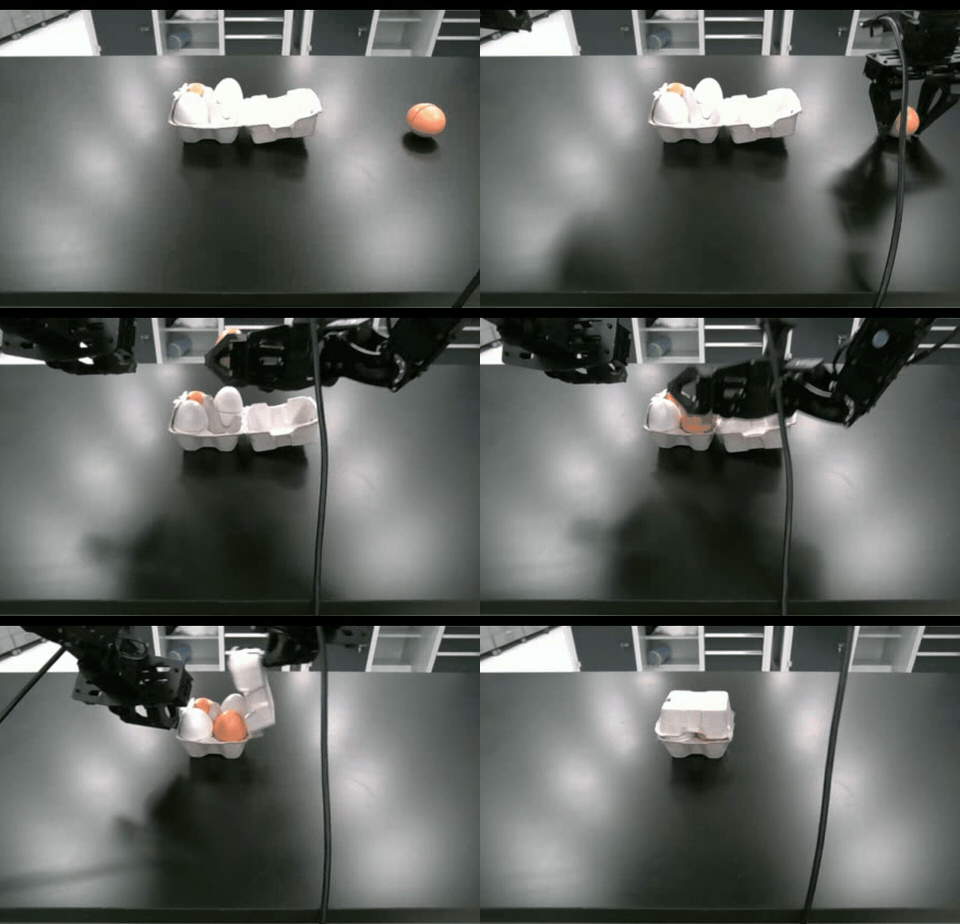
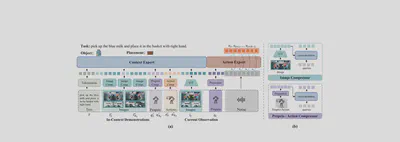
Although highly effective in vision and language domains, applying in-context learning to robotics remains challenging. Existing autoregressive in-context imitation methods discretize continuous actions and exacerbate the accumulation of early prediction errors through next-token prediction, limiting their generalization on unseen task configurations. Meanwhile, flow-matching policies have been explored for continuous robot control and can help mitigate compounding errors; however, in-context imitation learning within a flow-matching framework remains underexplored. To address these limitations, we introduce ContextFlow, a conditional flow-matching model that learns continuous action distributions for in-context imitation learning. ContextFlow conditions flow-based action prediction on demonstrations and observations, enabling robust generation from noisy action distributions. To better encode multimodal in-context demonstrations, we adapt perceiver-style multimodal context compressors that distill visual, proprioceptive, and action sequences into compact, task-relevant latent representations. On LIBERO, ContextFlow outperforms ICRT by 35 percentage points in average success rate on unseen task configurations, while matching the performance of the task-specific fine-tuned VLA model π0 without any fine-tuning on unseen tasks. On real robots, it generalizes to unseen configurations of both single-arm and bimanual tasks, achieving 40% success on a new pen-uncapping configuration.
Type
Publication
European Conference on Computer Vision
Real-robot demos and more results are on the project page.