EgoPlay: Event-Triggered Video Editing for Egocentric Streams
Sep 15, 2026·,,,,,,,,,,·
1 min read
Jinjie Mai
Gordon Guocheng Qian
Willi Menapace
Arpit Sahni
Chaoyang Wang
Ashkan Mirzaei
Runjia Li
Sergey Tulyakov
Bernard Ghanem
Peter Wonka
Rameen Abdal
Abstract
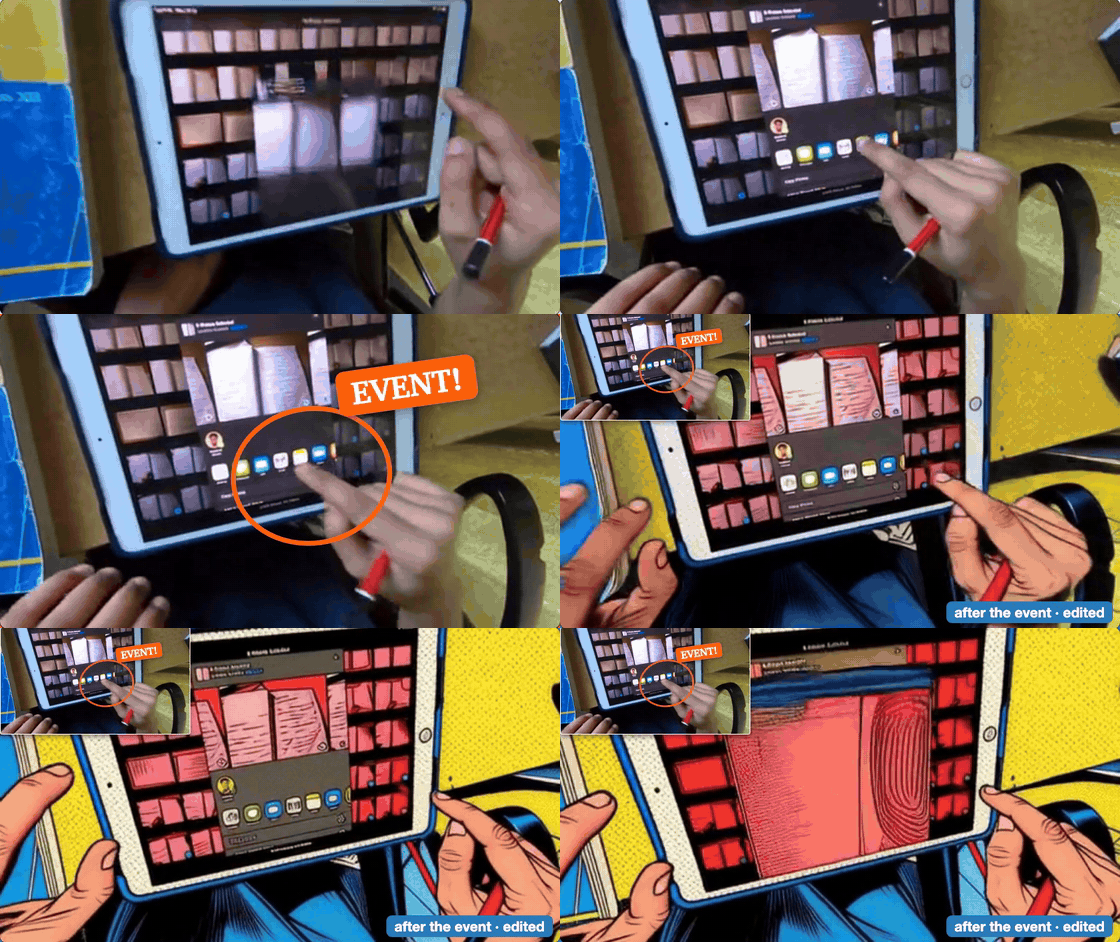
We introduce EgoPlay, an event-triggered video-to-video editor for egocentric streams, obtained by fine-tuning a pretrained V2V diffusion transformer on event-conditioned data built primarily from Ego4D. Given a monocular video and an event-triggered prompt of the form “when X happens, do Y,” EgoPlay infers whether and when event X occurs, preserves pre-event frames, and applies edit Y only to the post-event continuation. Rather than cascading a separate event detector with an editor, EgoPlay learns event recognition, temporal restraint, and pixel-level editing jointly in a single end-to-end model, while also handling negative and multi-event prompts. To support this, we construct a large-scale dataset of 106K event-triggered clip-prompt pairs spanning positive triggers, fabricated-trigger negatives, and multi-event prompts. We then train a bidirectional video diffusion editor with event-triggered supervision and derive a causal variant for chunk-by-chunk streamable inference. We further introduce an event-aware evaluation protocol that separately measures post-trigger editing quality, pre-trigger preservation, and false-trigger robustness. On the Ego4D benchmark, EgoPlay substantially outperforms EgoEdit, the state-of-the-art instruction-based egocentric video editing baseline, with relative gains of 17.7%, 16.9%, and 16.4% in editing quality, visual quality, and background consistency. It also surpasses a VLM-guided detector-editor baseline by 15.7%, 14.5%, and 13.5% on the same metrics, while using less than half the GPU memory.
Type
Publication
ACM SIGGRAPH Asia
More results, comparisons and the benchmark are on the project page.